BUILD · Built, not consulted
Anthropic just spent ten cities pitching Claude to small business. Here's what you should actually do.
The biggest AI lab in the room walked into the SMB conversation in May. We've been running this work for two years. Here's the gap between what the tour pitched and what an operator should do on Monday.
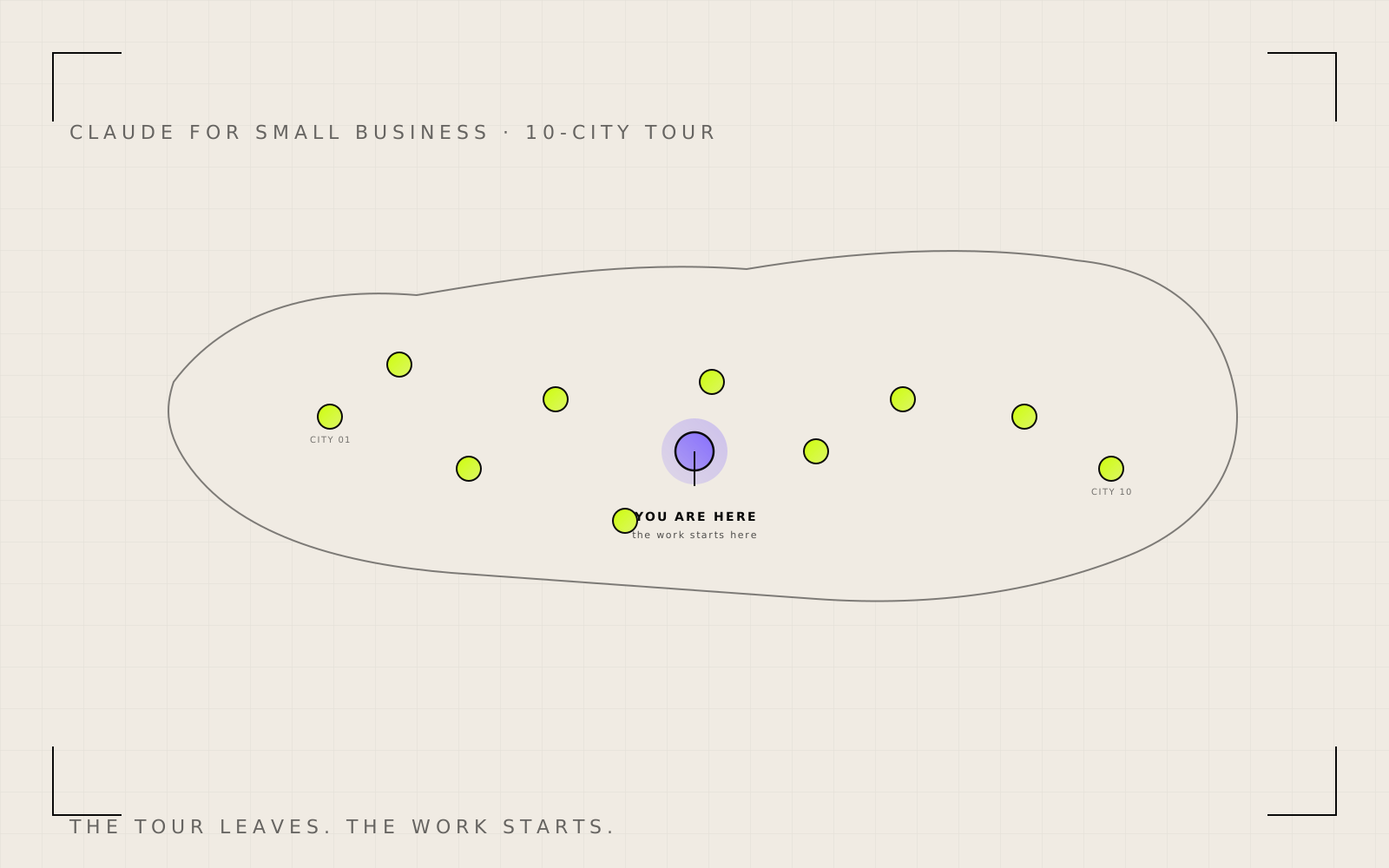
The biggest lab in the room just walked into the room you're standing in
In May, Anthropic took Claude on the road. Ten US cities. The pitch: small businesses are the next frontier for AI, and the company that built Claude wants to be in that conversation. The tour was the loud, visible signal that the labs have stopped treating SMBs as a long-tail and started treating them as a market. Confirm the exact city list and tour dates on Anthropic's official channels before you quote them. What we want to talk about isn't what the tour covered. It's what the tour means.
This is a real moment. Big-tech-meets-SMB cycles don't happen often. When they do, they reshape the next eighteen months of how small businesses think about a category. Cloud did it for IT around 2010. Stripe did it for payments around 2014. The labs are doing it for AI right now. The tour is the marker.
But there's a gap between what the tour answers and what an SMB owner actually needs to decide on Monday morning. The tour answers the easy question. Which model should I look at. It doesn't answer the harder one. What should I run on top of it, in what order, with which person owning the work. That second question is what we do for a living. So we wrote this for the owner who reads the press release, gets a flash of optimism, and then looks at her own business and wonders what specifically to do.
If you're skimming, the bolded beats are the whole article. If you've got eight minutes, the rest is where the actual answer lives, and there's a worked example of the conversation we'd run with you about halfway down.
Why the labs care about you now
For a long time, the AI labs cared about three customer shapes. Enterprises with eight-figure budgets. Developers who would build on top of the APIs. Consumers who would pay twenty dollars a month. SMBs sat awkwardly in the middle of all three: too small to land-and-expand, too non-technical to self-serve the API, too cost-sensitive to absorb consumer pricing across a team.
That math changed in 2025 and 2026. Three things shifted at once. Inference costs dropped enough that the per-seat economics work for a five-person team. Anthropic and OpenAI both built business-tier offerings that look closer to a typical SaaS contract than an enterprise procurement cycle. And the August 2025 MIT NANDA study made it unambiguous that the failure pattern in AI pilots wasn't the model. It was the gap between what the model could do in principle and what the actual workflow inside a real business needed. Closing that gap is a services problem more than a product problem, but the labs need the seats sold first before anyone can close anything.
So they're in your city. They're in your inbox. They're at your local chamber-of-commerce breakfast. That's a feature, not a bug, as long as you know what to do with the attention.
What the tour actually answers (and what it doesn't)
The tour does a few things well. It shows you, in person, that the model is real and usable. It walks operators through demos of common SMB use cases. Drafting, research, customer support, basic operations. It gives you a sense of what the seat-pricing looks like and how to onboard a small team without an IT department.
What the tour doesn't do, by design:
It doesn't pick your first workflow for you. The demos are illustrative. They don't know that your bottleneck is the after-hours leads going to voicemail, or the weekly compliance report that eats four hours of senior time, or the seven inboxes nobody owns. The model is the same in every demo. Which workflow to point it at is the part that has to come from inside your business.
It doesn't tell you who's going to run the AI on Monday. Across every engagement we've shipped, the single strongest predictor of whether an AI system survives is whether there's a named internal owner with operational authority and time blocked. Pilots without that named owner stall inside six months. The tour can't name that person for you.
It doesn't tell you whether your data is in shape. We worked with a small services business last year whose customer records were spread across three tools under three different spellings of the same person's name. The lesson generalised: AI inherits the mess of the system it plugs into, and tells you about the mess at scale. The tour shows a clean demo on clean data. Your data is the data you actually have.
It doesn't tell you what to not do. That's the most useful thing a thoughtful advisor can do for an SMB. Tell you which three workflows to leave alone for now. The labs aren't in the business of telling you which of their seats you don't need.
None of this is a criticism. It's the difference between a model and a system, and the gap between them is the entire reason small businesses keep struggling to get return on AI even as the models keep getting better.
The conversation we'd run with you instead
When an owner reaches out to us after a launch like this one, our first conversation isn't about Claude. It's five questions in a specific order. The order matters. Skipping a question doesn't speed it up; it just moves the failure later.
The questions, in plain English:
- Process Clarity. Could a new hire run your most experienced employee's job from documentation alone? If the answer is no, the AI has nothing to automate. It will automate whatever messy approximation the new hire cobbles together in their first three weeks.
- Data Availability. Could we pull a clean list of your active customers in under ten minutes from one system? If three sources and a manual reconciliation are involved, your data is technically available and practically unavailable, and any AI you plug in will inherit that.
- Tool Stack Maturity. Of your top five software tools, how many were built after 2020 and have working APIs you actually use? If three of them are legacy with PDF exports, you've got a stack problem to solve before the AI problem.
- Team Capacity. If we built a workflow this quarter and handed it to you, who owns it on Monday morning? If the answer takes longer than five seconds, you have a Team Capacity gap and no AI tool is going to fix that.
- ROI Potential. Name the single workflow that, if it ran by itself, would save the most time or money. How much? If the answer is vaguer than a dollar figure or a clear hours-per-week count, the bottleneck hasn't been named yet, and naming it is the first work to do.
Five questions. Score each one between one and five. Add them up. The total tells you which of three things to do next: audit before you spend, build exactly one workflow, or go cross-functional. We wrote the framework up in detail in the Wordwise AI Readiness Score article, and the free version of the assessment on our site runs the full version of it in about fifteen minutes.
The point isn't the score. The point is that walking through those five questions, honestly, in that order, is the first thing an SMB owner should do after a Claude-for-Small-Business pitch lands. Not in addition to it. Before it.
[CTA BUTTON: "Take the free AI Readiness Assessment" → /assessment/. Subtext: "Fifteen minutes. Free. Written report. No call, no sequence."]
What an AI system that actually works looks like
Talking about workflow design in the abstract is cheap. The real cost is in the build. So here's a system that already runs.
A digital marketing agency came to us managing Google Business Profiles for more than eighty disaster restoration companies across the United States. Each profile needed fifteen posts a month. Each post needed to read like the post came from someone who actually knew the business, the local market, and what disaster was top-of-mind that week. A flooded basement in Burlington in March is not the same story as a wind-damaged roof in Savannah in October.
The SEO lead was spending three hours every weekday producing posts. The workload was getting bigger as the agency added clients. Quality was drifting because there was no realistic way to research each business properly at that pace. The team that was supposed to be doing strategy was trapped in production.
We built one system. n8n underneath. Claude in the middle. Airtable on the surface. Per-business research that pulled service mix, seasonal calendar, local landmarks, recent reviews. Seasonal context. Local hooks. AI-drafted post. Human review queue in Airtable. One-click approve-and-publish. One operator scanning the fleet in the morning, editing where editing was needed, approving what was clean.
The numbers, post-launch:
- 80+ Google Business Profiles running through the same engine
- About 1,200 posts a month going out across the fleet
- Three hours daily → two hours weekly for the operator who runs it
- 93% reduction in review time for the lead who used to produce manually
- One operator keeps the whole fleet moving
That's what an AI system that actually works looks like inside a real business. One workflow. One owner. Measurable output. Ninety-day proof window. The model under the hood matters less than the architecture around it. Swap Claude for the next model that comes out and the system keeps running. Yank the architecture out and put just the model in its place and you're back to three hours a day of manual production with slightly better drafts.
You can read the full build at the GBP Automation case study.
What we'd tell an SMB owner to actually do this month
Not next quarter. Not after the next launch. This month, while the tour is still fresh.
One. Write your top three workflows on a piece of paper. The ones that eat the most senior time or generate the most after-hours problems. If you can't draw any of the three on a whiteboard in ten minutes, your Process Clarity score is a two. That's the first thing to fix, and it costs you nothing.
Two. Against each of the three, name the person inside your company who could own an AI system that automates it starting next month. If no name comes to mind for any of them, the first move is to hire, promote, or designate that person. Not to buy a tool. We mean this.
Three. Take a free AI Readiness Assessment before you commit a single dollar to seats or contracts. Fifteen minutes of diagnostic work usually saves an order of magnitude more spend that doesn't return. Use ours. Use someone else's. Run it on yourself. We benefit when an SMB owner does this work even if they never end up working with us.
Four. When you do buy seats (Claude, OpenAI, anything else), buy narrow before you buy broad. One team. One workflow. Ninety-day proof window. Expand from there. Buying broad before buying narrow is how the 95% pilot failure rate gets generated.
Five. Watch for vendors making earnings claims that sound too clean. The FTC sued Air AI for $19 million in deceptive earnings claims aimed at small business owners last summer. The tour from the labs is reputable. Most of the noise around it isn't, and the noise is what costs SMB owners the most money in cycles like this.
Frequently asked questions
What does it mean that Anthropic is pitching small business directly?
It means the labs see SMBs as a primary market now. That's good news. It also means the volume of marketing aimed at small business owners about AI is going to go up sharply over the next twelve months, and the signal-to-noise ratio is going to drop. The Claude product is real. So is OpenAI's equivalent. The pitch decks around them, from the labs and from third parties, are going to be where the trouble starts. Trust the model. Question the demos. Run the audit before you sign anything.
Should I wait for the next launch before buying anything?
No. The model is good enough today to ship real workflows. Waiting on the next launch is a way of avoiding the harder work, which is picking the first workflow and naming the owner. That work is the same whether you start today or in six months. The right move is to do the readiness work now and start small with whatever model is best when you're ready to build. Switching models later is the easy part.
How long does it actually take to ship a useful AI workflow inside a small business?
For one well-scoped workflow with the right ownership in place: thirty to ninety days from kickoff to a working system running in production. The GBP engine took roughly six weeks of build time and was running across the fleet inside ninety days. Scoping and readiness work happen before that and can take another two to four weeks if there are gaps to close.
Do I need to know how to prompt Claude to get value from this?
No. Prompting is a skill, and a useful one. But for a workflow-level AI system to run inside your business, the prompting is one layer of a larger architecture. The architecture matters more than any individual prompt. If you're the owner and you're learning to prompt, that's fine and probably useful. The system you actually need someone to build for you isn't a prompt. It's a pipeline.
What if my business is so small I'm the only person and there's no one else to own the AI system?
Then the owner is you, and the framework still works. The questions just collapse: can you, the founder, point to the one workflow you want to automate, the data it needs, the time you can block each week to run it? If yes, the build is small and fast. If no, do the readiness work on yourself before you do anything else.
What the labs can't tell you
Here's the thing the tour can't tell you, because no one on the tour is sitting inside your business.
The model isn't the bottleneck anymore. It hasn't been the bottleneck for about eighteen months. The bottleneck is the gap between a powerful model and a working system inside a small business that already has its own data, its own tools, its own people, and its own pile of work that's been there long before anyone was talking about AI.
Closing that gap is what we do. It's also what any thoughtful SMB owner can do for herself, if she runs the readiness work in the right order and resists the urge to buy broad before she buys narrow.
The tour is the invitation. The actual work happens at the desk where the spreadsheet lives.
[CTA BUTTON: "Take the free AI Readiness Assessment" → /assessment/. Subtext: "Fifteen minutes. Free. Written report. No call, no sequence."]
FAQs
What is Anthropic's Claude for Small Business?
Anthropic, the AI lab behind Claude, launched a small business focused offering in May 2026 with a ten-city US tour aimed at SMB owners. The product packages Claude access with onboarding, templates, and use-case examples designed for businesses that don't have an in-house AI team. The tour was a concrete sign that the biggest labs now see SMBs as a primary market, not a long-tail. From an operator standpoint, the product is real and the model is excellent. The question is no longer whether Claude can do useful work for a small business (it can). The question is what work, in what order, with what data flowing in and out. That part the tour doesn't answer for you, and it isn't supposed to. Confirm exact tour dates and city list on Anthropic's official site before quoting them externally.
Does my small business actually need Claude or any AI tool right now?
Probably not in the way the marketing implies. The honest answer for most SMBs is that buying AI seats doesn't move the needle until two things are true. First, you've named the specific workflow that's costing you the most time or money, in concrete terms. Second, there's a real human inside the business who can own the AI system on Monday morning. Without those two, paying for Claude or any other AI tool produces curiosity, not return. With those two, you're set up to get value from almost any modern model. The cost of getting this wrong used to be a few hundred dollars a month and some sunk hours. With the new SMB-focused contracts and the temptation to roll AI out across the whole company, the cost of getting it wrong is climbing. Name the workflow first. Buy the tools second.
How is Wordwise different from Anthropic's SMB offering?
Anthropic sells the model, the seats, and the surrounding templates. We use the model to build the actual workflow that runs inside your business. Different layer of the same problem. The tour shows owners what Claude can do in principle. We show up after that conversation and answer the question of what specifically to build first, what data has to feed it, who runs it on Monday, and how to know in ninety days whether it worked. We're not a reseller and we're not in competition with the labs. We're the architects who plug the model into the rest of your stack so something actually ships. For a working example, one of our engines uses Claude under n8n and Airtable to manage Google Business Profiles for over eighty disaster restoration companies. About 1,200 posts a month. Two hours a week to operate.
What's the most common mistake SMBs are about to make with the new wave of AI tools?
Buying broad before buying narrow. The pattern we keep seeing is the owner reads about a launch, signs up the whole team for seats, mandates that everyone use AI in their work, and three months later nobody can point to a single workflow that's measurably better. The tool got rolled out before the work got picked. A better order: pick one workflow that has a real dollar cost, build the AI workflow that targets it, prove the value inside ninety days, expand from there. The MIT NANDA research released last August found 95% of enterprise and SMB AI pilots failed to reach production or measurable ROI, and the failure pattern was almost always a workflow-and-ownership gap, not a model gap. The labs can't fix that for you. Picking the right first workflow can.
If I'm an SMB owner and the Claude tour came through my city, what should I do this week?
Three things, in order. One, write down the top three workflows in your business on a piece of paper. The ones that eat the most senior-employee time or generate the most after-hours problems. Two, against each one, name the person inside your company who could own an AI system that automates it starting next month. If no name comes to mind for any of them, that's the first hire or promotion to make, not the first tool to buy. Three, take a free AI Readiness Assessment (ours or anyone else's) before you commit budget. Fifteen minutes of diagnostic work usually saves an order of magnitude more in spend that doesn't return. The tour was the loud part. The quiet part is the work you do at your own desk this week.
What does an AI system that actually works in an SMB look like, concretely?
Look at the Google Business Profile engine we built for a digital marketing agency. The agency was managing GBPs for more than eighty disaster restoration companies. The SEO lead was spending three hours every day producing posts, and the posts were drifting into generic copy because the workload was too big to research each business properly. We rebuilt it as one system: per-business research, seasonal context, local hooks, AI drafting under Claude, editorial review queue in Airtable, automated publishing. Result: 1,200 posts a month across the fleet, two hours per week for one operator to keep the whole thing running, and a 93% reduction in review time. That's what an AI system that actually works looks like. Not 'we rolled out Claude.' One workflow, one owner, measurable output, ninety-day proof window.
Where can I read more about how Wordwise scopes an AI project?
Our AI Readiness Score framework is the published version of the conversation we run before any engagement. Five dimensions, scored one to five each, total out of twenty-five. Process Clarity, Data Availability, Tool Stack Maturity, Team Capacity, ROI Potential. The framework is open and free to use. We wrote it up in detail in the Wordwise AI Readiness Score article. The free assessment on our site runs the full version of it in about fifteen minutes and returns a written report with your tier and your ninety-day next move. No call, no follow-up sequence.
Keep reading
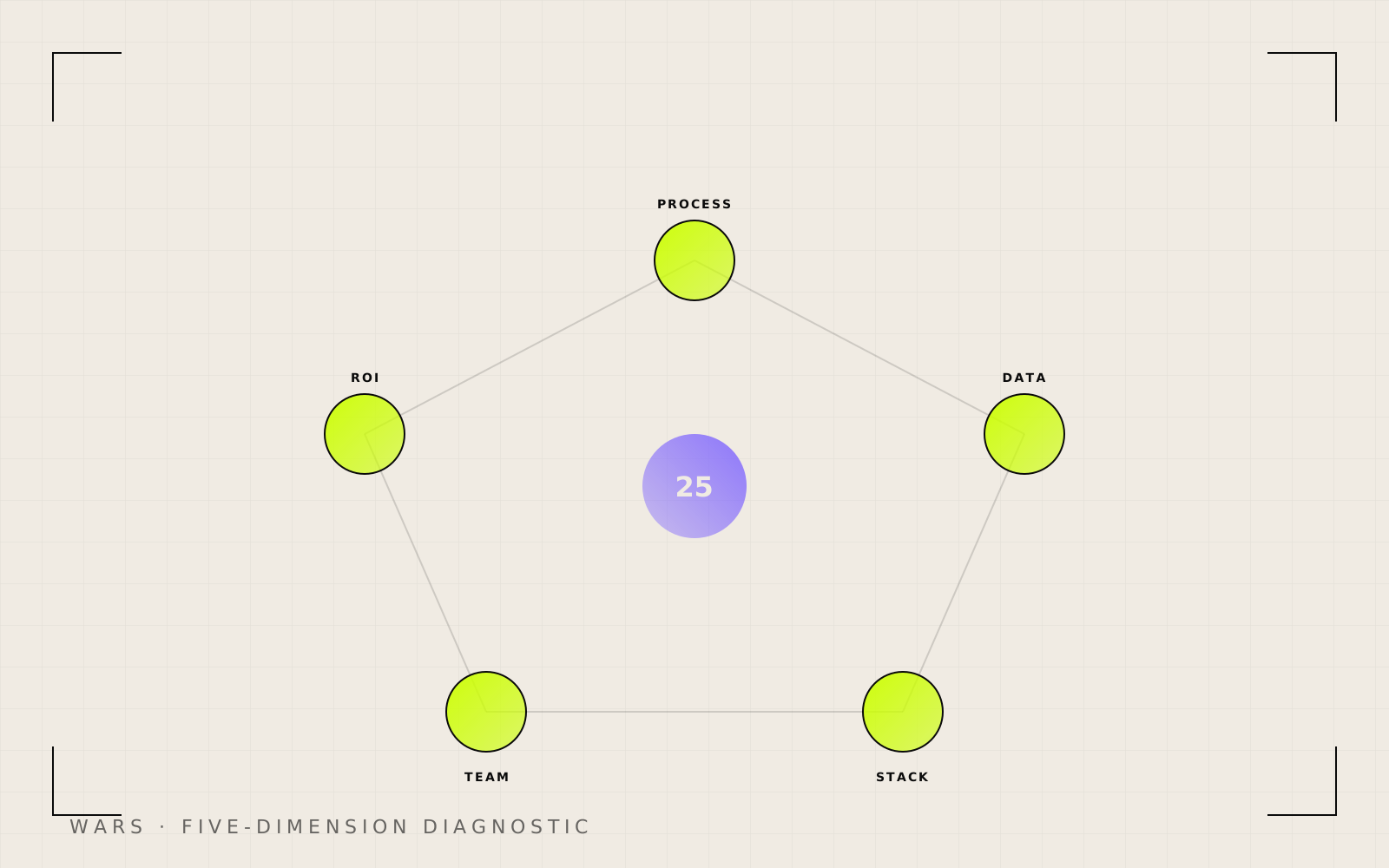
The Wordwise AI Readiness Score: how to know if you're ready before you spend a dollar
95% of SMB AI pilots fail. The Wordwise AI Readiness Score takes five minutes and tells you whether to audit, build one workflow, or go cross-functional.
Roni Ravikumar · 17 min read
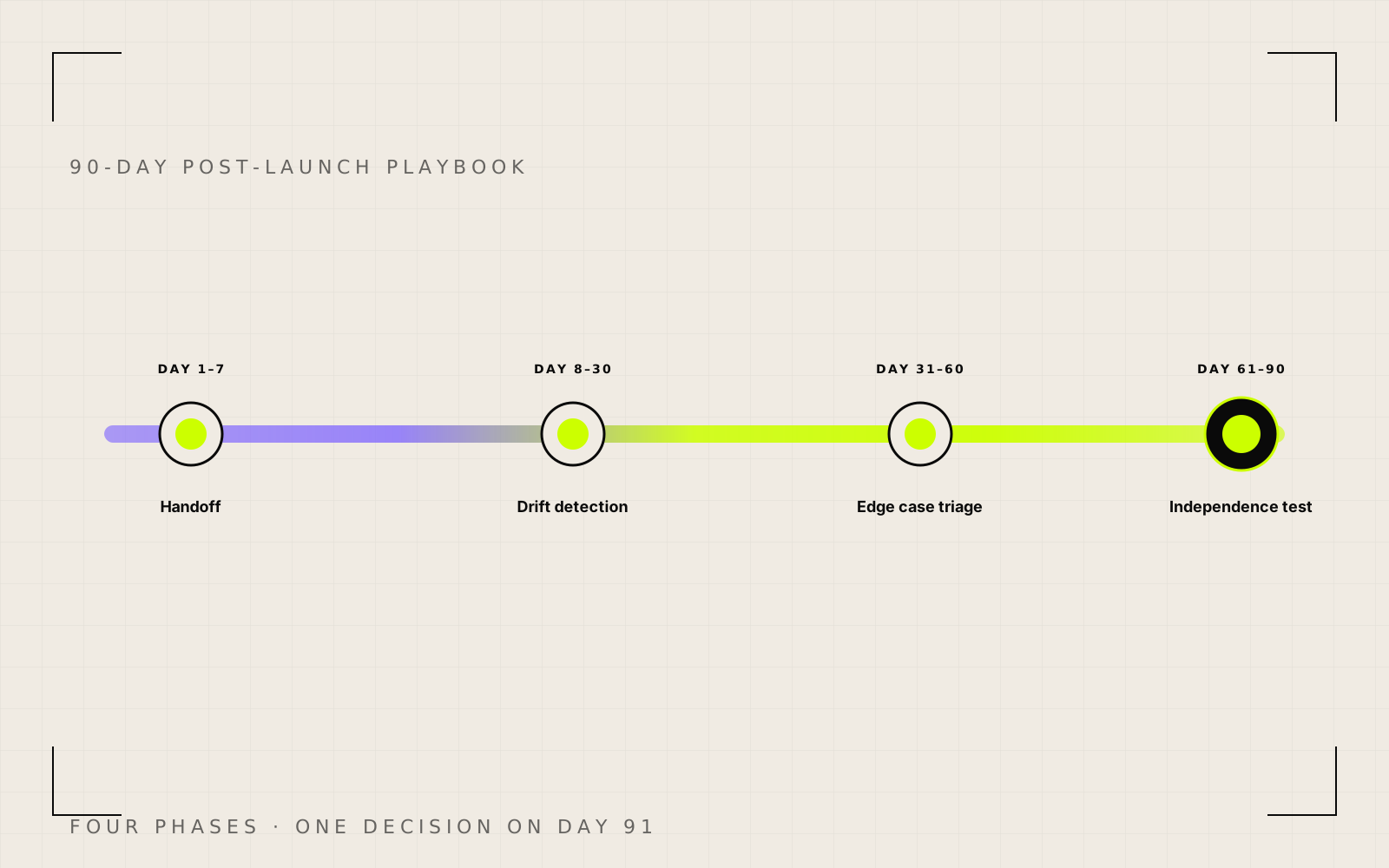
The 90-day post-launch playbook: what a real AI agency does after go-live
Most AI builds die quietly inside 90 days because nobody owned them after go-live. Here is the 90-day post-launch playbook a real AI agency runs.
Roni Ravikumar · 15 min read
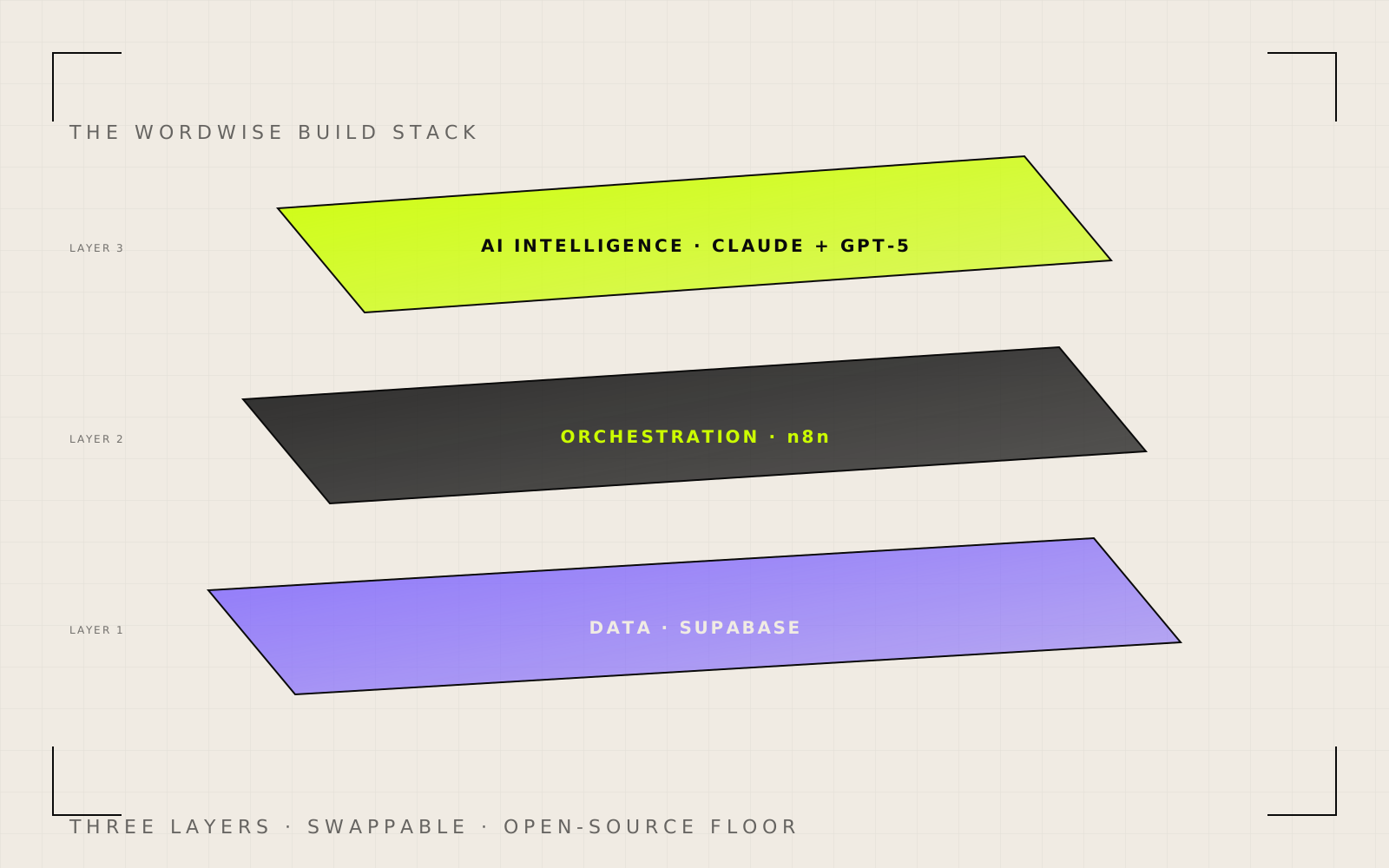
The Wordwise build stack: what we use, why, and when we'd choose differently
The exact stack we use to ship AI automation for SMBs. n8n, Claude, Supabase, Resend, Cal.com, Cloudflare. Costs, trade-offs, when we'd pick differently.
Roni Ravikumar · 20 min read