AUDIT · Audit before you automate
The Wordwise AI Readiness Score: how to know if you're ready before you spend a dollar
A five-dimension diagnostic that scores your business out of twenty-five — so you know whether to audit, build one workflow, or go cross-functional.
The honest question almost nobody is asking
Most AI advice is written as if the only question is which tool should I buy. It isn't. The harder question, the one nobody seems to ask out loud, is whether you're set up to get any return from buying anything in the first place.
Picture a forty-person roofing business whose owner wants to add AI to handle inbound calls because his team keeps losing leads after 6pm. Reasonable problem, reasonable instinct. But the actual question isn't "which voice agent should I buy." It's "what happens to my CRM if I plug a voice agent into it on Tuesday." Different question. Different answer. And the gap between those two questions, scaled across about ninety-five thousand SMBs trying the same thing this year, is where most of the money is getting lit on fire. We'll come back to that owner throughout the piece. The conversation we walk through with him later in the article is invented, but the shape of it is something we run two or three times a week.
If you're skimming, the bolded beats are the whole article. If you've got eight minutes, the rest is where the actual answer lives, and there's a real conversation with that roofing owner about halfway down that you'll want to read.
An August 2025 study from MIT NANDA tracked enterprise and SMB AI pilots and found 95% of them failed to reach production or measurable ROI. The failure wasn't about the model. It was about the gap between general-purpose AI and the real workflows it was meant to plug into. That same year, surveys of AI rollouts inside small businesses tagged tool fatigue as a primary drag, with somewhere near 1 in 5 employees describing the experience that way [estimate, multiple industry reports]. The FTC sued Air AI for $19 million in deceptive earnings claims aimed at small business owners. Three different angles, same story underneath. Companies bought AI before they knew what they were buying it for.
We built the Wordwise AI Readiness Score because we got tired of writing variations of the same email to potential clients. Yes, AI can help. No, please don't buy that platform yet. Here's what we'd want to know first. The score is the email, formalized.
How the score works
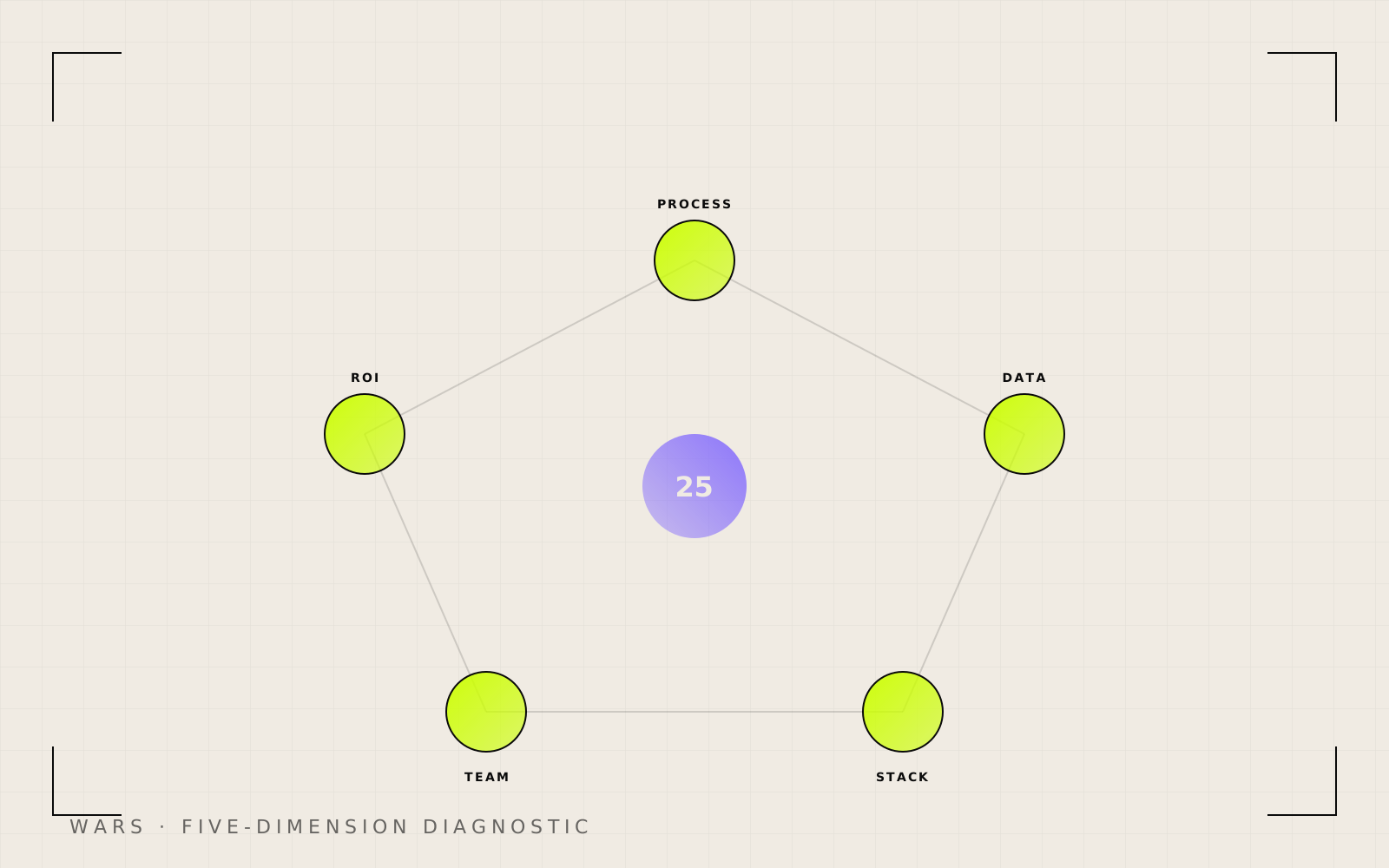
Five dimensions. Each one is scored from one to five against a written rubric. Add them up. You get a number out of twenty-five.
That number maps to one of three tiers, and each tier has a different next move. Zero to fourteen, we tell you to audit before you spend a dollar. Fifteen to nineteen, we tell you to build exactly one workflow and prove it works inside ninety days. Twenty and above, we tell you the harder, more interesting conversation about cross-functional AI is on the table.
We chose five dimensions because four felt like we were missing the point of view of whoever was going to own the work, and six felt like we were padding for the sake of looking thorough. Five was the smallest number that didn't leave anything important on the floor.
The five dimensions, in the order they tend to break for the SMBs we talk to:
- Process Clarity. Is the work written down anywhere a new hire could find it.
- Data Availability. Can the data be reached and trusted.
- Tool Stack Maturity. Will the tools you already pay for talk to anything new.
- Team Capacity. Is there a real human inside the business who can own this.
- ROI Potential. Is the bottleneck big enough that fixing it returns more than the fix costs.
You'll notice the model isn't on this list. That's deliberate. We think which model you use is the easiest question of the five, and almost never the one that decides whether a pilot survives contact with reality.
The five dimensions, in plain English
Process Clarity, or: the head of operations who walked out
There's a particular kind of small business where one person knows how everything actually works. She remembers which client prefers email and which one prefers WhatsApp. She knows that the welcome packet has to go out within two days, but only because the contractor who built the website three years ago mentioned it in passing once. She doesn't have a process document because the process is her.
Then she leaves. And the next person walks in on Tuesday with a list of clients and no idea what she actually did.
This is the dimension that most SMBs underrate. AI is, at heart, a way to automate a process. If the process only lives in one person's head, the AI has nothing to automate, and what it ends up automating is whatever messy approximation the new hire has cobbled together in their first three weeks. Or worse: it doesn't automate anything, it just generates a confident-sounding wrong answer at scale.
The question we ask: if your most experienced employee left tomorrow, could a new hire run their job from documentation alone? Most owners say no the first time. That's fine. Naming the gap is most of the work.
Data Availability, or: the customer with three spellings
We worked with a small services business last year that had the same customer entered in their CRM as Jonathan Walsh, in their billing tool as Jon Walsh, and in their email platform as John Walsh. When they tried to use an AI agent to send personalized follow-ups, the agent confidently sent three different campaigns to one human being. Two of them addressed him by a name he doesn't go by.
Garbage in, very confident garbage out. That's the dimension.
Data Availability isn't really about whether you have data. Of course you have data. It's about whether the data is somewhere reachable, whether it's clean enough to act on, and whether you can pull it without three people getting on a call. If your active customer list lives in two systems and a spreadsheet, your data is technically available and practically unavailable, and any AI you plug in will inherit the mess.
The question we ask: if we asked you for a clean list of your active customers right now, how long would it take and how many sources would you check? Anything over ten minutes or two sources scores below a three. Honest answer in the room.
Tool Stack Maturity, or: the Access database from 2011
There's a real business we know that runs its inventory through a Microsoft Access database somebody built in 2011. The original developer is retired. The export format is PDF only. The company is profitable, the team is sharp, and they want to add AI to forecast restock cycles. We had to tell them: the model isn't the problem. The PDF is the problem.
Tool Stack Maturity is the most boring dimension and one of the most decisive. AI workflows need to pull data from where it lives and write outputs to where work gets done. Anywhere along that chain that lives on a 2011 desktop tool, a custom one-off, or a vendor that gates API access behind enterprise pricing, the chain breaks.
This isn't a rip-and-replace pitch. The fix is usually narrower than that. But if four of your top five tools are modern SaaS with APIs you actually use, you're set up. If three of them are legacy with PDF exports, you've got a stack problem that has to get solved before the AI problem.
The question we ask: list the top five software tools your business runs on. How many were built after 2020? The answer is usually two or three.
Team Capacity, or: the one person who has to own this on Monday
Across every engagement we've run, the single strongest predictor of whether an AI build survives is whether there's a named internal owner with operational authority. The pattern is so consistent it's almost boring. Pilots without that named owner stall inside six months. Pilots with one almost always clear the first year. The owner is rarely a technical person. She's usually the operations lead, or the sharpest project manager, or in one case we know of, the founder's assistant.
The test we use during scoping: ask the owner who will run the AI on Monday morning. If the answer is instant and specific, that's a five on this dimension. A name, a face, a calendar already adjusting around it.
If your answer is we'll figure that out later, it's a two at best. If your answer is we don't have anyone, it's a one and you should not start a build. That's not us being precious. It's the single most reliable predictor in the entire framework. We think this is the most overlooked dimension of the five, and here's why: technical work without an internal owner gets quietly abandoned within six months, every single time we've watched it happen.
The question we ask: if we build a workflow and hand it off, who owns it on Monday? If the answer takes longer than five seconds, you have a Team Capacity gap.
ROI Potential, or: name the bottleneck, name the number
The fifth dimension is the one that separates a real pilot from a vanity project. Salesforce's 2025 SMB AI ROI report benchmarked typical AI workflow savings at five hundred to two thousand dollars a month for the first deployed workflow. That range only holds when the workflow actually targets a bottleneck. Automating something that wasn't slow, expensive, or painful generates the appearance of progress and zero return.
The roofing owner from our opening, the one we're using as a worked example, can tell you off the top of his head that he loses about thirty after-hours leads a week, that callbacks convert at 12% versus 35% when caught live, that his average job is worth roughly four thousand dollars. He has the bottleneck in his head and he has the number on it. That's a five.
Compare that to an owner who says his bottleneck is probably something with marketing. That's a one. Not because marketing isn't a real bottleneck somewhere in his business. Because he hasn't done the work yet to name it.
The question we ask: name the single workflow that, if it ran by itself, would save the most time or money. How much? Anything vaguer than a dollar figure or a clear hours-per-week count scores below a three.
The three tiers, in plain English
Once you've got a total out of twenty-five, you land in one of three tiers. Each one has a different next move, and the move actually matters more than the score.
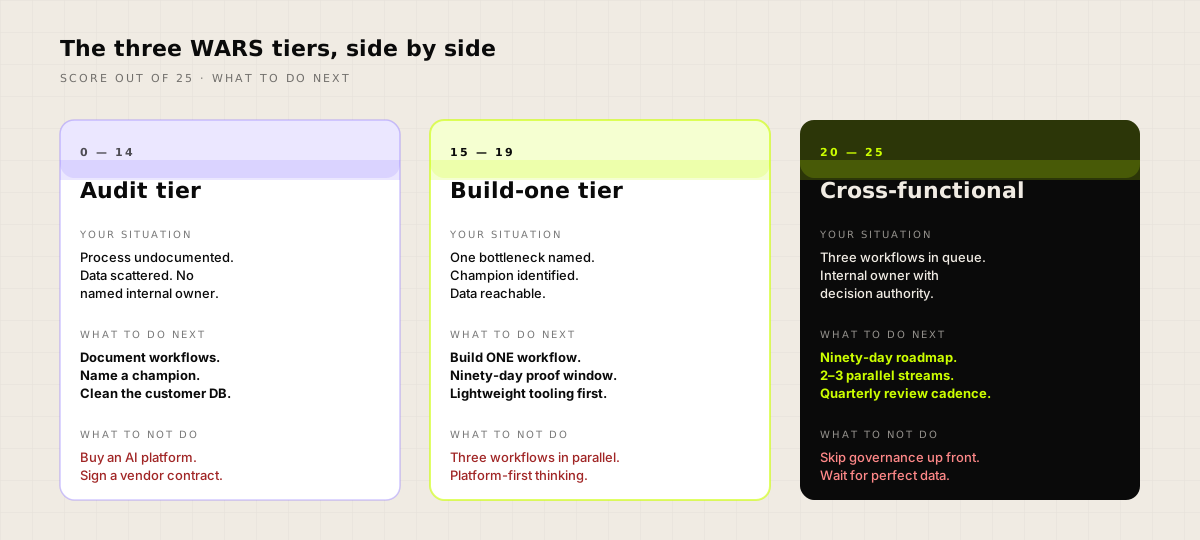
Zero to fourteen, the audit tier. You are not ready to buy AI tools yet, and any vendor telling you otherwise is selling. The work to do first is diagnostic, not technical. Document the top three workflows. Name a champion. Clean the customer database. Decide on a real ROI target. Most SMBs we talk to land here today. That's not a bad score. It's the most common honest starting point, and it has a defined next move that costs you nothing but time.
Fifteen to nineteen, the build-one tier. You're ready for one workflow. Not three. Not a platform rollout. One. Pick the highest-ROI bottleneck the score surfaced, build it, prove the value inside ninety days, then expand. We've watched companies attempt three workflows in parallel at this tier and we've watched all three end up half-built. Sequential beats parallel here, every time. Lightweight tooling first (n8n, Zapier, Make), measurement plan defined before the build starts, and a champion with hours actually blocked.
Twenty to twenty-five, the cross-functional tier. You're ready for the more interesting conversation. Custom agents, multi-system integration, AI baked into how the business runs. The question stops being can we use AI and becomes what's the right next investment. We recommend a ninety-day roadmap with two or three parallel workflow streams, governance defined upfront, and a quarterly review cadence so drift gets caught before it compounds.
Score yourself in five minutes
Grab a piece of paper. Or just hold the numbers in your head. Five questions. Be honest. A low score with a clear next move is more useful than a high score you talked yourself into.
Process Clarity. Could a new hire run your most experienced employee's job from documentation alone? One means no. Five means yes, with confidence.
Data Availability. Could you pull a clean list of active customers in under ten minutes from a single system? One means no. Five means yes.
Tool Stack Maturity. Are four of your top five software tools modern SaaS with APIs you actually use? One means no. Five means yes.
Team Capacity. Is there a named person in your business who could own an AI system starting next month, with hours blocked and the authority to actually decide things? One means no. Five means yes, named, with calendar time.
ROI Potential. Can you name a single bottleneck and the dollar or hour cost it generates every month? One means no. Five means yes, with hard numbers.
Add the five. That's your starting WARS.
Want the full diagnostic instead of the five-minute self-score?
Twenty to thirty questions across the same five dimensions. Fifteen minutes. Free. Written report with your tier, dimension-level gaps, and a ninety-day recommendation. No call. No sequence.
Take the 5-min assessmentA walkthrough conversation. Invented, but the shape is real.
A note before the dialogue. What follows is invented. Not because we don't have these conversations (we run versions of this about three times a week), but because the operators in those calls haven't agreed to be quoted, and we don't put words in real mouths. The shape of the questions and the order they get asked is what's real. The names and the numbers are illustrative. We're walking the same roofing example from earlier through to its scoring conclusion.
Owner: "We're a forty-person roofing contractor. I want to use AI to handle the inbound calls because we're losing leads at night. What should I buy?"
Us: "Before the tool, two questions. When a call comes in tonight, what happens to it right now?"
Owner: "It goes to voicemail. My ops manager checks the voicemail in the morning, transcribes the call into the CRM, assigns it to a sales rep, and the rep calls back. Usually by 10am."
Us: "How many leads come in after hours per week?"
Owner: "Maybe thirty."
Us: "How many of those convert when you call back the next morning, versus the ones you catch live during the day?"
Owner: "Live conversion is around 35%. Callbacks are maybe 12%."
Us: "So you're losing roughly thirty leads a week to a twenty-three-point conversion gap. At your average job size, that's real money. Process clarity is high. You've got ROI Potential nailed. Now the harder question. Your CRM is HubSpot. Your phone system is RingCentral. Do they talk to each other today?"
Owner: "Not really. Someone on the team exports a CSV every Friday and uploads it."
Us: "That's the Tool Stack Maturity gap. Who's the person doing that CSV upload? Would they be willing to take on something new?"
Owner: "If I gave her time, yes. She's the best operator I have."
That whole exchange takes about twelve minutes. The WARS estimate lands at 17/25. Build phase one. One workflow: an after-hours voice agent that captures the call, qualifies the lead against three criteria, books a callback in the calendar, writes the record into HubSpot. Ninety-day proof window. Champion: the named operator the owner just identified. ROI target: eight additional closes per quarter at his current job size. Tooling: a Vapi voice agent talking to n8n talking to HubSpot. No platform purchase. No four-month consulting engagement. Just the bottleneck, the number, the owner, and the smallest thing that could prove the case.
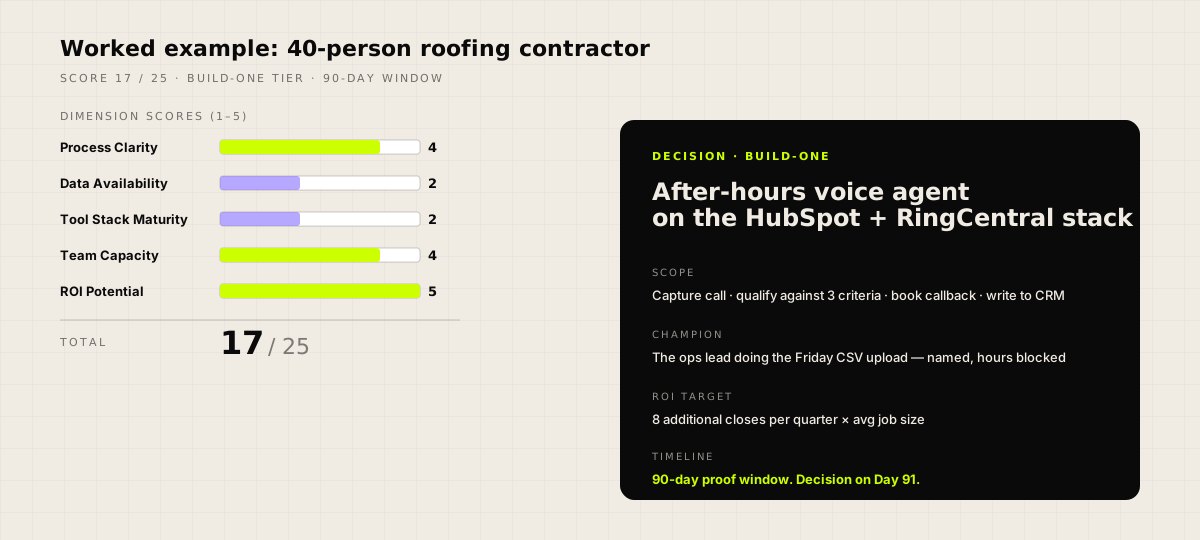
The whole shape of the engagement gets set inside fifteen minutes, because the framework asked the right questions in the right order. That's the framework working, and we wanted to walk you through it so you'd see what scoring a real (and yes, invented for the page) situation actually looks like.
What the 5% do differently
The MIT study didn't stop at the 95% failure number. The research team also looked at the 5% that worked, and the pattern they summed up was unambiguous: the survivors pick one pain point, execute well, and partner smartly with the companies whose tools they actually use. The same study found that buying from specialized vendors and building partnerships succeeded about 67% of the time, while internal builds succeeded only one-third as often.
That maps directly onto WARS. The successful 5% scored high on Process Clarity, because they picked one pain point and could describe it in concrete steps. They scored high on Team Capacity, because the champion was named before the contract was. They scored high on ROI Potential, because the pain point was quantified, not just felt. The 95% scored low on at least one of those three and proceeded anyway.
The lesson isn't that you need a perfect twenty-five to start. It's that the gaps you don't name before the build are the same gaps that kill the build in month four.
What the score does NOT tell you
WARS is a diagnostic. Not a guarantee. We say this clearly because most assessments are dressed up as predictions, and that's dishonest.
Not a benchmark against other companies. We don't publish percentile rankings. The score is about your business, not a leaderboard.
Not a vendor selection tool. WARS tells you whether you're ready. Which tool to pick once you are ready is a different question with different inputs.
Not a guarantee of project success. A 22/25 means the conditions for success are present. Execution still has to happen, and we've watched 22/25 builds fail because leadership lost focus in month four. We've also watched 16/25 builds succeed because the champion was relentless.
Not a Wordwise product. Open methodology. Anyone is welcome to use it.
What to do tomorrow
Three actions. Whether you ever work with us or not.
Score yourself in five minutes. Use the questions above. Be honest. A 9/25 with a clear next move beats a 19/25 you talked yourself into.
Write down your top three workflows. If you can't draw them on a whiteboard in ten minutes, your Process Clarity score is a two. That's the first thing to fix and it costs nothing.
Name a champion before you buy anything. If you can't point to the person who'll own the AI system on Monday morning, you aren't ready. Hire one, promote one, or wait. Don't skip this step. We mean it.
Why we even built this
Here's the thing nobody tells you about frameworks. They're never really about the score.
We didn't publish WARS because the world needed another AI assessment. The world has plenty. We published it because the conversation that the score forces is the actual product. When an owner walks through five honest questions and lands on a number, the number isn't the point. The point is that they now know which workflow to obsess over, which spreadsheet to clean up first, who the champion needs to be, and what the dollar figure looks like. They couldn't have said any of those things on Monday morning. By Tuesday afternoon they can.
That's it. That's why this exists. The score is the artifact. The honest conversation it forces is the actual work.
We benefit when the framework gets cited. We benefit more when an SMB owner who never works with us still ends up running the audit on themselves because the framework was findable on a Tuesday afternoon in June.
Get the full diagnostic by Monday
Fifteen minutes. Free. Written report with your tier, dimension-level gaps, and a ninety-day next move. No call. No sequence.
Take the 5-min assessmentFAQs
What is the Wordwise AI Readiness Score?
WARS is a five-dimension diagnostic that scores your business out of twenty-five on whether the conditions are in place for an AI workflow to actually work. The dimensions are Process Clarity, Data Availability, Tool Stack Maturity, Team Capacity, and ROI Potential. Each one gets a score between one and five against a published rubric. Add them up. The total maps to one of three tiers: audit, build one workflow, or go cross-functional. We built it because 95% of SMB AI pilots fail, and the failure pattern is almost always a readiness gap that nobody named before the spend started. The framework is open. Anyone can self-score from the questions in this article. The full version lives in our free assessment and comes back as a written report with the gaps and the next move.
How do I know if my small business is ready for AI?
Answer five questions honestly, one per dimension. Could a new hire run your most experienced employee's job from documentation alone? Could you pull a clean list of active customers in under ten minutes from one system? Are four of your top five tools modern SaaS with working APIs? Is there a named person who can own an AI system starting next month, with hours actually blocked? Can you name a single bottleneck and the dollar cost it generates every month? Score each one to five. Add them. Under fifteen, audit first. Fifteen to nineteen, build one workflow. Twenty and up, you are ready for broader AI work. Most SMBs today are under fifteen, and that is a useful answer, not a bad one.
What is the AI pilot failure rate for small businesses?
An August 2025 MIT NANDA study tracked enterprise and SMB AI pilots and found 95% failed to reach production or measurable ROI. The research team identified the gap as the difference between general-purpose tools and the real workflows they were supposed to support, not the model itself. That same year, surveys of AI rollouts inside small businesses tagged tool fatigue as a primary drag, with somewhere near 1 in 5 employees describing the experience that way [estimate, multiple industry reports]. The FTC sued Air AI for $19 million in deceptive earnings claims aimed at small business owners. Three different angles, one pattern underneath. Companies bought AI before they knew what they were buying it for. WARS exists so that question gets answered first.
Can I score my business in five minutes without hiring anyone?
Yes. The DIY version lives in this article. One question per dimension, scored one to five, totalled to a tier. The whole exercise takes about five minutes if you are honest. The full assessment is twenty to thirty questions, takes about fifteen minutes, and returns a written report with dimension-level gaps and a ninety-day recommendation. The full one is free and there is no follow-up call unless you ask for one. We run it before every Wordwise engagement, and we run it for businesses who never end up working with us. The readiness work is worth doing regardless of who runs the build at the end. A low score with a clear next move beats a vague AI strategy deck every time.
What is the difference between WARS and a generic AI assessment?
Most AI assessments score whether you are using AI. WARS scores whether you are ready to use AI well. The distinction matters. A company can be using ChatGPT for marketing copy and still score eight out of twenty-five, because the underlying processes are undocumented, the data is messy, and nobody owns the work. Another company can be using zero AI today and score twenty-one out of twenty-five, because everything else is in place. WARS is also not a vendor selection tool. It does not tell you which platform to buy. It tells you whether the conditions for any AI workflow to succeed are present. And it is published openly. Other agencies and consultants are welcome to use it. We benefit when the framework gets cited, not when it gets gated behind a sales call.
What should I do if I score zero to fourteen?
Audit before you buy. Spending in this tier is how the 95% failure rate gets generated, and the work you need to do first is diagnostic, not technical. Document the top three workflows in your business. Name the person who will own AI initiatives if you start them. Clean the customer database. Decide what the ROI target actually is in dollars per month. Once those four are in place, your score moves into the build tier and the next move gets a lot clearer. The audit usually takes thirty to sixty days of internal effort. It does not require buying any AI tools. It does not require hiring an AI agency, although some businesses bring us in to run it alongside them. The path that does not work is skipping the audit and buying a platform on faith.
Keep reading
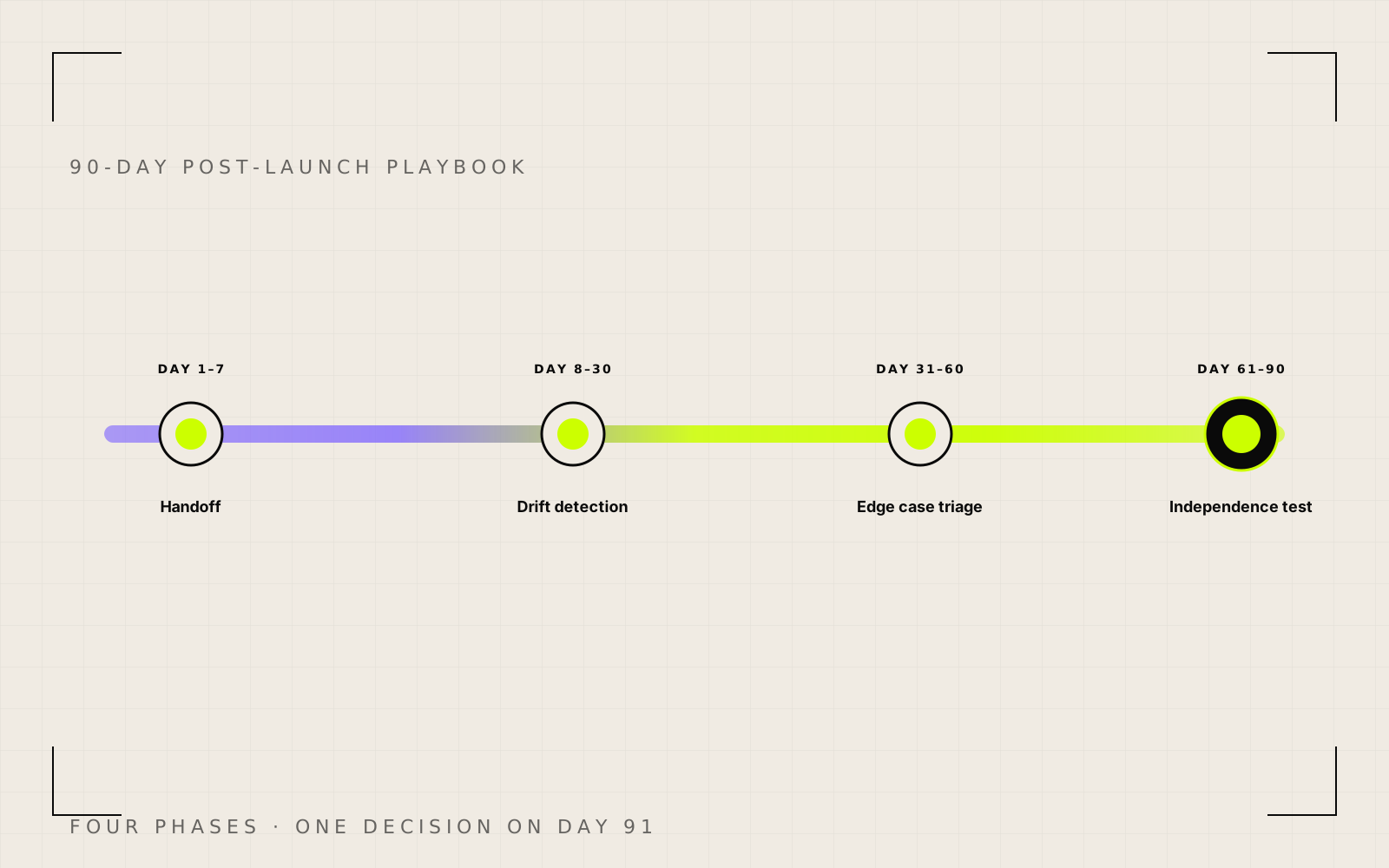
The 90-day post-launch playbook: what a real AI agency does after go-live
Most AI builds die quietly inside 90 days because nobody owned them after go-live. Here is the 90-day post-launch playbook a real AI agency runs.
Roni Ravikumar · 15 min read
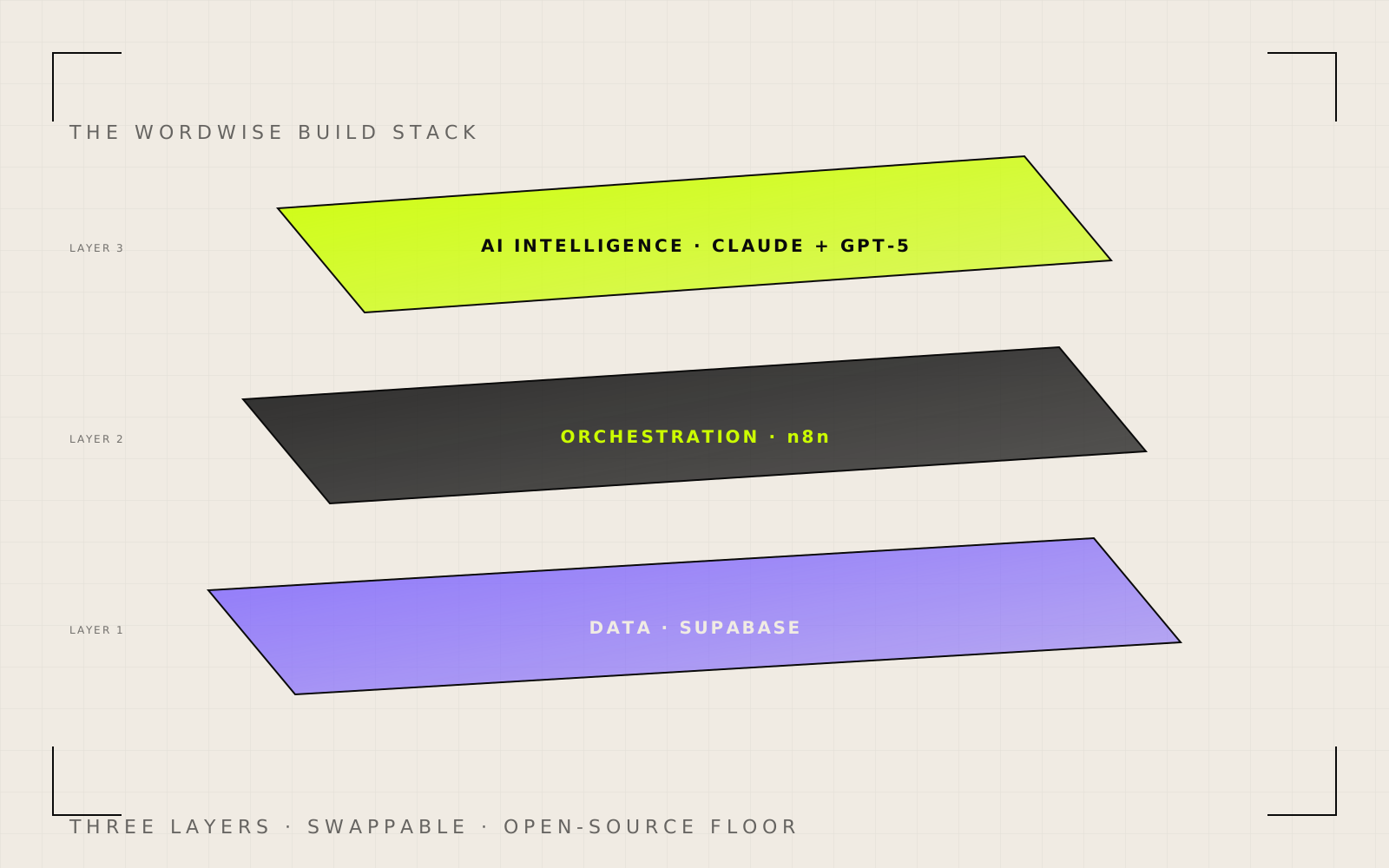
The Wordwise build stack: what we use, why, and when we'd choose differently
The exact stack we use to ship AI automation for SMBs. n8n, Claude, Supabase, Resend, Cal.com, Cloudflare. Costs, trade-offs, when we'd pick differently.
Roni Ravikumar · 20 min read
Anthropic just spent ten cities pitching Claude to small business. Here's what you should actually do.
Anthropic took Claude on a 10-city tour pitching small business owners on AI. The tour answers the wrong question. Here's the conversation we'd run with any owner before they buy a single seat.
Roni Ravikumar · 13 min read